Düsseldorf in January 2026: Investments, Climate Protection, and Digital Future
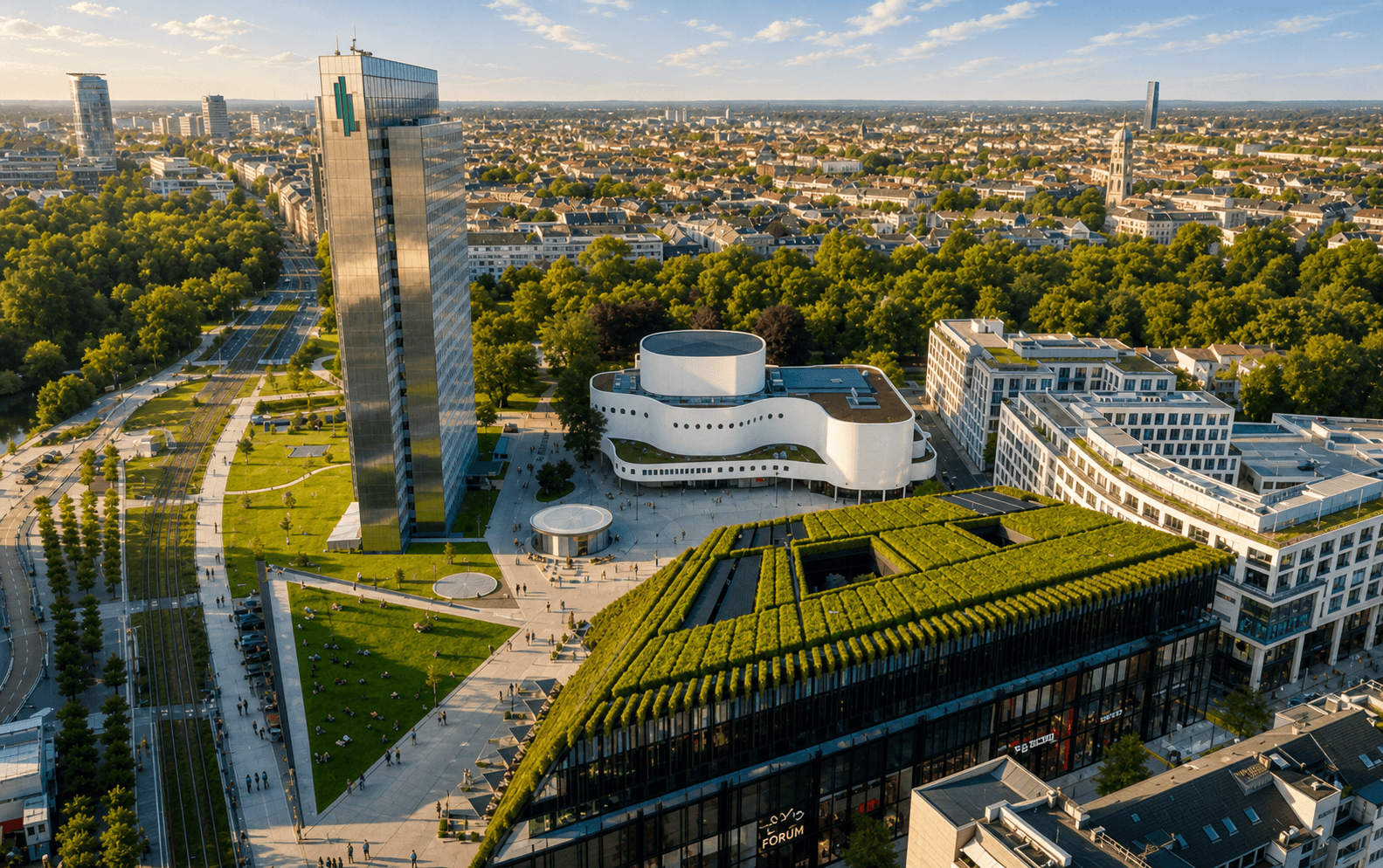
In January 2026, Düsseldorf set impulses in transport, housing, climate protection, and digitalization. Here is the monthly review.
Impulses for the Future
What was important this month
- Theodor-Heuss-Brücke: The replacement construction without tram tracks was approved – with a cost of 36.892 million EUR.
- Housing: New kindergartens, a grammar school, and subsidized housing illustrate urban policy in construction.
- Climate Protection: 30 km/h zones, green roofs, and solar panel systems place climate protection on the agenda.
- Digitalization: With an ICT budget of 58.9 million EUR, Düsseldorf accelerates digital projects.
- Traffic Management: FDP motions to reduce construction chaos and promote cycling.
Transport and Mobility: Safety and Future
January 2026 marked a decisive turning point in Düsseldorf's transport policy. With the approval of the replacement construction of the Theodor-Heuss Bridge (THB) without a tram track, the city is prioritizing a long-term solution that emphasizes safety and traffic management. The cost of 36.892 million EUR includes extensive safety measures such as higher railings and reinforced cantilevers. The construction will last three years and will involve closures of pedestrian and cycling paths – a challenge for commuters and residents.
At the same time, Düsseldorf is placing stronger emphasis on cycling. New bike lanes are being created on Gubener Straße, and structural improvements are planned at several intersections, including Grafenberger Allee. 30 km/h zones in several districts aim to increase road safety and reduce noise.
The FDP has also submitted a motion for coordinated construction site management to reduce traffic chaos during construction. This reflects a growing awareness of the needs of citizens.
Housing and Urban Development: Future-Proof Neighborhoods
In urban development, Düsseldorf set clear impulses in January. With the proposals for Planstraße Oberbilk and Benrodestraße/Marbacher Straße, future-oriented neighborhoods are being planned. In Oberbilk, road areas will focus on cycling, sidewalks, and greenery. In Marbach, 200 residential units will be built, 40% of which are subsidized, along with a school and urban design highlights such as green roofs and solar panel systems.
In addition, the „Bau-Turbo“ according to § 36a BauGB was approved to accelerate approval procedures. This is a step toward more efficient urban development. In educational construction planning, two new kindergartens and a grammar school were planned with a focus on energy efficiency and barrier-free access.
The Phoenix Tower is to receive an adjustment to its usage concept, with a “Sky Lounge” instead of a “Sky Bar” and 89 rent-reduced apartments. These impulses show how Düsseldorf is not only creating living space but also integrating social components into urban development.
Climate Protection and Digitalization: Future Technologies for the City
In the field of climate protection, Düsseldorf set accents on multiple levels in January. 30 km/h zones, green roofs, and solar panel systems in new buildings show how the city is actively fighting climate change. The Noise Action Plan IV foresees renovations of the A59 motorway with noise-optimized asphalt and plans for sound-insulating windows on digital platforms.
Another highlight is the introduction of a scoring model to assess the digital dividend. This model evaluates 13 criteria and aims to help enable digital opportunities for all citizens. At the same time, the 2026 ICT budget of 58.9 million EUR was approved, including projects such as eSchool, digital citizen services, and body cameras for the police.
These investments show that Düsseldorf is not only protecting the environment but also shaping the future of the digital city.
Culture, Education, and Social Affairs: Diversity and Inclusion
Düsseldorf remains committed to cultural and social issues. The „Transformation Process Diversity“ focuses on greater inclusion in cultural policy. The Fotostadt Düsseldorf Commission has been newly appointed, and the Museum Kunstpalast is to be renovated with additional costs of 2.682 million EUR.
In education, the city is investing in modern infrastructure: The new building of the Leibniz-Montessori-Gymnasium with DGNB Gold certification and fire safety renovations is a milestone. In addition, the organization „Flüchtlinge Willkommen in Düsseldorf e. V.“ is recognized as a free provider of youth welfare services, strengthening integration.
In social policy, continuous wastewater screening for drugs is being evaluated, and the Kommunaler Integrationsmanager (KIM) is to be expanded to include violence prevention in the healthcare sector. These measures show how Düsseldorf is responding to complex social challenges.
Connections: Investments, Safety, and Digitalization
Düsseldorf is moving on multiple levels in January 2026: in transport policy, the city is focusing on safety and long-term planning. At the same time, cycling is being promoted, which is not only environmentally friendly but also makes the city more livable. In urban development, there is an emphasis on social mix and energy efficiency – a signal for sustainable neighborhood development.
Digitalization is also being used as a key topic to improve services and overcome the digital divide. Investments in ICT projects, body cameras, and digital platforms show that Düsseldorf is not only focusing on the future of technology but also on the future of its citizens.
Conclusion and Outlook
January 2026 was in Düsseldorf marked by investments in infrastructure, climate protection, and digitalization. The city is setting impulses in transport, housing, education, and social affairs – with a clear focus on safety, sustainability, and inclusion.
In February, construction work on the Theodor-Heuss Bridge will begin, and digitalization projects will become more concrete. The city is moving along a path that combines future-readiness with social responsibility.
NeoSearch analyses public council documents, committee minutes and municipal announcements. Source references appear automatically once verified meeting data is available.
What does this mean for businesses?
Municipal council decisions are early indicators: following the council agenda surfaces projects and tenders months before the official award — before they ever reach the procurement portals.
Track similar decisions in your region
Set up monitoring for kommunale Projekte in Nordrhein-Westfalen — prefilled from this article.
Set up monitoring →More signals from Duesseldorf
Educational Policy in Düsseldorf: Safety, Capacity, and Innovation in Focus
In April 2026, educational policy in Düsseldorf focused on safety issues, capacity expansion at special needs schools, and innovative projects to prevent school avoidance. The School Committee addressed central challenges and reform approaches that will shape the future of the educational system in the state capital.
Read more → Youth Policy in Düsseldorf: Focus on Psychosocial Support, Democracy, and Poverty Reduction in April 2026
In April 2026, Düsseldorf has taken several key steps in youth policy. From psychosocial support for young people to the implementation of democracy projects and the fight against child poverty: The Youth Welfare Committee is setting impulses for a resilient and livable city for young people.
Read more → Düsseldorf's Integration and Housing Policy in April 2026: Focus on Participation, Antiracism, and Legal Security
In an intense April 2026, Düsseldorf took decisive steps in integration and social policy. The focus was on issues such as antiracism, linguistic and social integration, legal security in homeless shelters, and the strengthening of migrant organizations. The Committee for Equal Opportunities and Integration made key decisions that will shape future policy.
Read more →